No One Wants to Talk to You; Here’s How to Get the Sale Anyway

Last time updated: September 28, 2026
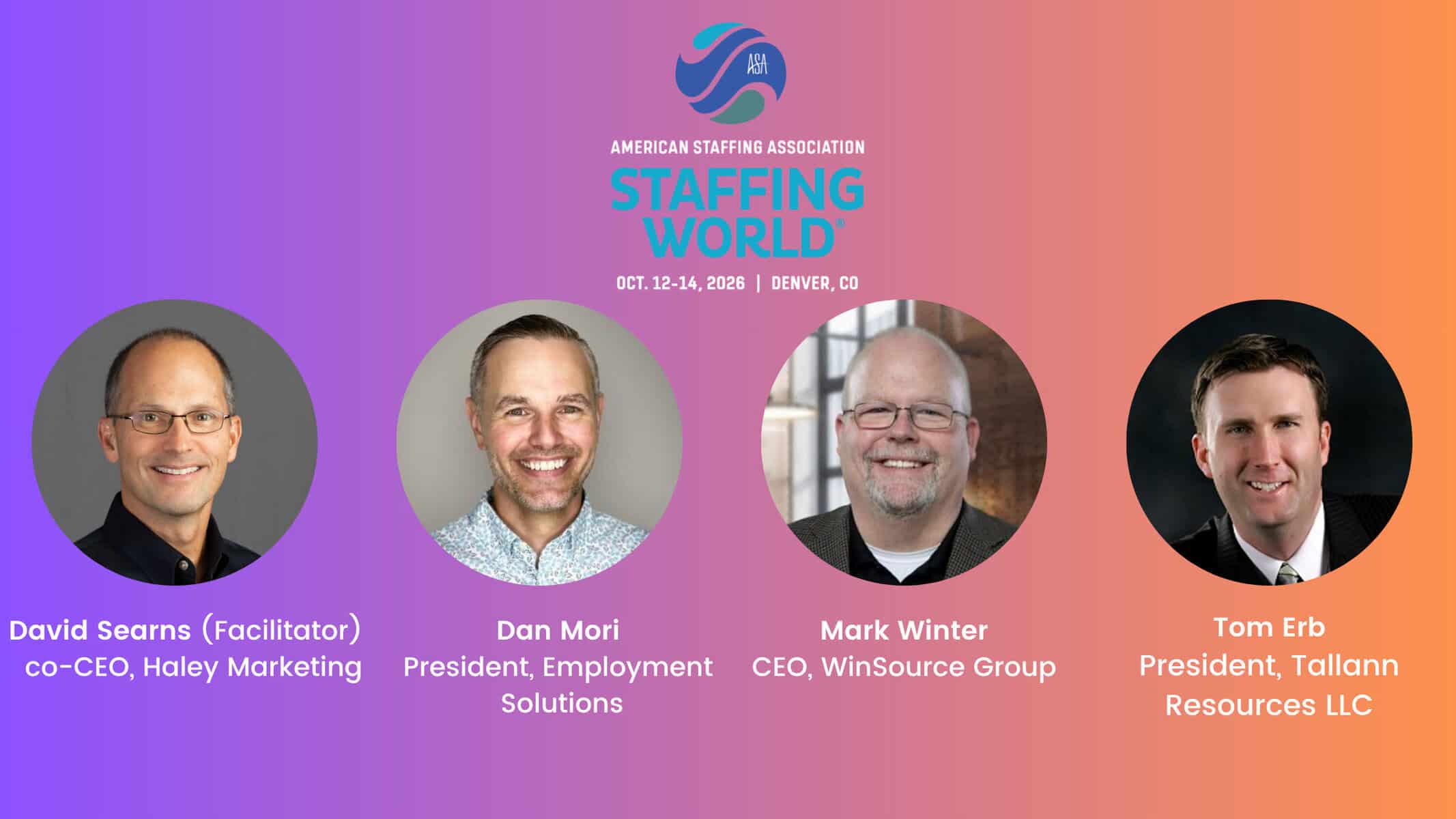
Staffing World Breakout Session | Tuesday, Oct. 13 | 1:45 pm – 3 pm
When it comes to staffing sales these days, no one wants to talk to you. And it’s not because people are rude—it’s overload. Buyers are burned out, buying complexity is at an all-time high, and no one wants to be pitched.

So, how do you still close deals in that environment? There’s no better group to ask than Tom Erb, Dan Mori, David Searns, and Mark Winter. This panel is a seasoned group of industry experts who have shared the stage many times to tackle the toughest sales challenges.
“We wanted the opportunity to present at Staffing World because we knew that sales has been a hot button issue in the industry for a long time, but especially since 2022,” says Searns, who originally concocted the idea for the panel and will serve as moderator. “And I know from past experiences that this group has a ton of knowledge to share.”
This article is a preview of what is sure to be an enlightening panel at Staffing World that will distill their candid advice on how to win business in a difficult sales environment..
Traditional Approaches Won’t Cut It Anymore
The problem with traditional sales approaches is that there isn’t just one problem – there are many.
Evolving Industry
One of them is a rapidly evolving industry. Searns points to the headwinds the staffing industry has faced in the last few years and the changing nature of labor.
“The economy is just one of the things that’s caused it to be harder to sell. You’ve got more competition than ever from near shore and offshore, gig services, online platforms, and now we’ve got AI entering the mix for knowledge work. All these challenges are redefining how work gets done for employers.’”
Happy Ears
Winter mentions that a common issue that arises is “premature presentation” and ignoring customer cues.
“Staffing salespeople are often well intentioned and so excited about their solutions, they just assume that everyone wants to talk about it. But the reality is that most of the time, if the staffing conversation is happening, it means something is wrong.”
Mori adds, “We call that ‘happy ears’. As soon as salespeople get a hint of interest, the happy ears go up and they start spouting features and benefits. Meanwhile, the buyer is coming from a place of burnout and needs specific answers to their specific needs.”
It’s a delicate balance, Winter says, of balancing sales excitement while being thoughtful about where the customer is coming from.
Prove It
Erb mentions that in a mature industry where prospects have likely used staffing companies before, proof of differentiation is key.
“You’ve got to be able to show them that you can solve their problem where others haven’t been able to. And it comes down to proof – testimonials, case studies, awards, methodology, etc. The processes and methodology are the why behind it, and then the testimonials and case studies and awards are the proof that it actually worked.”
The DIYers
Winter also points out that efficient staffing agencies have made the work they do look easy, and many customers are wondering, ‘why don’t we just do it ourselves?’.
Mori adds that while good practitioners in the industry make thoughtful processes and good outcomes look easy, some agencies really are doing the bare minimum and are in a race to the bottom on price, which hurts the industry as a whole.
“We have become a service industry. That’s table stakes. If you’re in this industry to provide just people and not service, you’re in the wrong industry,” says Winter.
The Buyer’s Journey
The panel agrees that the modern buyer’s journey is more complex than ever before.
“No one has an extra fifteen minutes to tackle stuff because there’s so much being put on our plates,” says Mori. “In the rush to improve efficiency with new tools, the result is that people are burned out. And you have to ask yourself, how do burned out people respond? Well, they tend to make decisions only when that fire is the biggest. And you have to have done the work beforehand through messaging and positioning to make yourself the name that comes up within that limited mental bandwidth.”
The Pre-Call Decision
Winter mentions that as much as 50-80% of the B2B buying decision is made before the first conversation with a salesperson. Buyers are doing their own research online, in networking groups, and through past relationships and social proof.
“I think a lot of times the salesperson has been trained to go in and do discovery, to ask a ton of questions, then come back later with a solution to present,” says Searns. “Meanwhile, to the buyer, if you’re not walking in here already knowing what the problems are and able to intelligently talk about what you can do in the first call, they don’t want to hear your discovery.”
Erb also talks about the rise of the informational buyer.
“We’re all informed buyers. We don’t go out and just buy the first big screen television we see. We go online, we look at reviews, we ask our friends. The buyer is not just going to make an impulsive decision because you just happened to get lucky with a cold call. The salesperson has to provide information that the buyer can confirm.”
The Buying Committee
Gone are the days of a single decision-maker. Salespeople must navigate HR, purchasing, operations, and finance—each with different priorities and pain points.
“It’s almost like purchasing through homeowners’ committee these days,” says Winter. “That means a big portion of the sales job now is helping people navigate their own internal complexity. So if you’re not in the conversation, if you’re sitting in your office waiting for a callback…good luck!”
Searns adds that there is also quite a bit of pressure on clients to go faster and to do more with fewer resources.
“Senior management is putting pressure on teams to automate more and do more with fewer people, particularly in a cost center like HR. So the last thing they have time for is fifteen minutes to talk to a salesperson. They are doing research beforehand, and bringing in multiple roles like HR, purchasing, and operations into the room. So now the salesperson has to know how to talk to all of these audiences. And you better have done your research!”
He says that you have to walk in knowing that the table’s already been set for you to win the deal because the majority of the buying decision is done before the first meeting.
The Amazon Effect
The group mentions that modern buyers want a frictionless process. They expect to find the information they need online and make a decision quickly, sometimes even without a formal sales meeting.
“It’s the Amazon effect,” says Winter. “I want something, and I want to go get it now. If I need information on it when I go look for it, I’ll find the information I need.”
Searns mentions that the sales process looks a little different when it’s a new service or approach – but so few staffing companies are offering new service models.
“When MSP came onto the scene, people had to teach the customer what that meant. When RPO came onto the scene, same thing. So there’s an opportunity to have that educational, more traditional sales process when you have something new. But when you have something that people understand, it has to be a quick sales process, even if it’s consultative solution selling.”
Search Changes
Mori also mentions that the conversation around the problem statement has changed entirely.
“Back in the day, clients that would struggle with staffing might actually search ‘staffing agencies near me’. But now they’re searching ‘how do I solve this problem’ or asking ChatGPT the same question. So staffing agencies need to show up in those search results in a way to establish credibility, brand authority, but also being a viable solution again.”
Erb also mentions the rise of AI search. “It’s really important that staffing companies are out there and have enough information that the AI tools can say, ‘this is a legitimate staffing provider in your market that we suggest’.”
“It’s no longer just about seasonal fill,” adds Winter. “Now, it’s way bigger than that. The conversation has changed drastically.”
The New Playbook
An oft heard refrain in staffing sales is “we’re not hiring,” or the classic “no one needs a temp.” So how does a salesperson respond to that? The panel pointed to a few key ideas:
Reframing Your Value
Winter puts it like this: if the staffing game has changed, what is it that customers are buying from you? Stop selling “temps” or “placements”, says Winter, and start selling wins for busy HR departments that help them go from a cost center to a valuable part of their organization.
“They have tools available to them where they could do the whole thing themselves. But do they want to? We’re taking some kind of pressure off their shoulders. We’re doing a service for them in the organization. This gives them an opportunity, if we’re positioning this right, to bring a win to the table for their company. That’s what we’re selling.”
Speak Their Language
Mori says to tailor your message to what they are hearing every day from their own leadership—cost reduction, efficiency mandates, growth targets.
“When you’re pitching a workforce solution, frame it in a way that speaks to the corporate objectives that they are hearing every day from leadership. ‘Do you need to reduce turnover by X% while decreasing costs by X%?’ If we tailor our message and content and then tailor our services to support what they’re hearing every single day inside their organization, that makes it an attractive solution.”
Don’t Give Up
Erb says that, in his opinion, salespeople are giving up too fast – and not making enough calls. For him, the statement “we don’t use staffing” is not a rejection, but rather a conversation starter.
“If you are only doing 20-30 calls a week and then complaining that ‘no one answers the phone,’ yes, that probably is the case for you. With a small sample they get this idea in their head that nobody wants to talk, nobody’s buying, nobody’s answering the phone,” he says. “That’s not the reality of it. I like to look at it a different way. If you make 200 calls a week and get 192 voicemails but talk to eight people…where else can you all but guarantee to talk to eight decision-makers a week?”
Get to the Pain Point
Searns says that if someone is taking a meeting with you, look where their feet are. There’s a problem to be discovered, and when you have done your homework beforehand you can come in offering solutions.
“You can say, ‘most of my clients like you are dealing with A B C or D, are you dealing with this too?’. You’re not even talking about hiring, you’re not talking about staffing at all. You’re talking about the problems in their world.”
Erb adds that ‘We’re not using staffing right now’ is the best thing a salesperson could hear.
“The reason being, that’s an opportunity. That’s your competition moving away. If it’s a good candidate in your space, chances are they have used staffing before. And that’s an opportunity to nurture a relationship so that when they do have a need, you’re the first call.”
Marketing Matters
Mori also mentions that in modern sales, smart selling starts with marketing.
“Sales starts with effective positioning. You need to be talking to the right account, to the right person, at the right time.”
And finding out where the buyers spend time is also the job of marketing so that sales can go in armed with information.
“When you have someone who can analyze the data and see where buyers are coming from, then they enable the salespeople to do what they do best. When marketing and sales are playing to their strengths and supporting the same mission—that’s where the magic happens.”
Closing the Gap
The panel says that the firms that will win are those that close the gap between what buyers need and what most sellers are still offering. It’s about becoming a trusted advisor, not just another vendor, and taking up mental real estate with effective positioning and marketing. It’s about enabling sales to be in the best position to sell solutions when someone finally wants to talk to them.
And a great place to start is by attending what is sure to be an entertaining and educational Staffing World session that promises practical strategies, role-playing, and sage advice from a group of experts.
“The role of sales has expanded and we need to close the gap and make sure it aligns with what the buyers are actually buying,” says Mori. “And we’re going to teach people exactly how to do that in this panel.”
Thank you to the panelists for a great discussion! You can catch more insights from Tom Erb, Dan Mori, David Searns, and Mark Winter at the Breakout Session ‘No One Wants to Talk to You; Here’s How to Get the Sale Anyway’ on Tuesday, Oct. 13, from 1:45 PM – 3 PM.
Up Next




Read More Insights from Elle Jackson
-

A Billion Dollar Mistake: Why You Can’t Ignore Job Descriptions in an AI World
An interview with Kat Kibben on the “billion dollar mistake” in staffing – ignoring job descriptions in an AI world. -
Clarity Beats Chaos: How High-Performing Staffing Teams Stay Focused Under Pressure
This article interviews high-powered staffing leaders on practical strategies to move from chaos to clarity, drive real progress, and build a culture of accountable performance. (Preview of a Staffing World 2026 panel) -

The Practical AI Playbook for Staffing Firm Leaders
In this webinar replay, marketing and AI expert Jeff Staats offers a free educational webinar designed specifically for staffing firm leaders who want to leverage AI with confidence—not confusion. In this webinar recording, you’ll learn how to cut through the noise and identify practical ways AI can help your team work smarter, improve efficiency, and… -

What You Need to Know About California Senate Bill 1032 – the SAFE Act (SB 1032)
Everything you need to know about California Senate Bill 1032, also known as the SAFE Act, and how it impacts staffing agencies in CA.