Clarity Beats Chaos: How High-Performing Staffing Teams Stay Focused Under Pressure

Last time updated: September 28, 2026
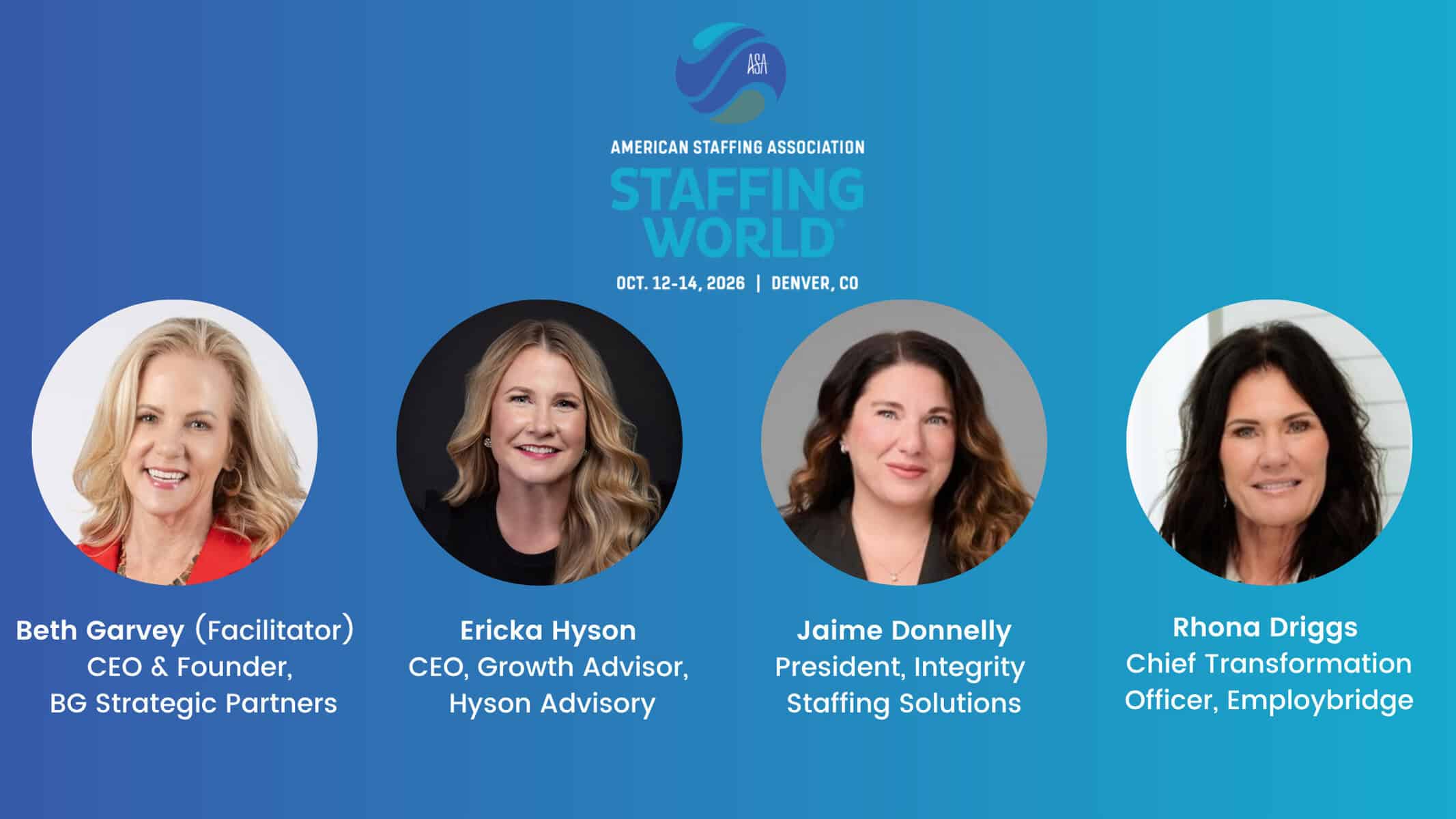
Staffing World Breakout Session | Tuesday, Oct. 13 | 11:30 am – 12:15 pm
In staffing, everyone is busy all the time. It’s easy to get caught up glorifying ‘busyness’—how many calls you make, how little white space you have on your calendar, how many meetings you have lined up. But the question is: is your team doing more work, or the right work?

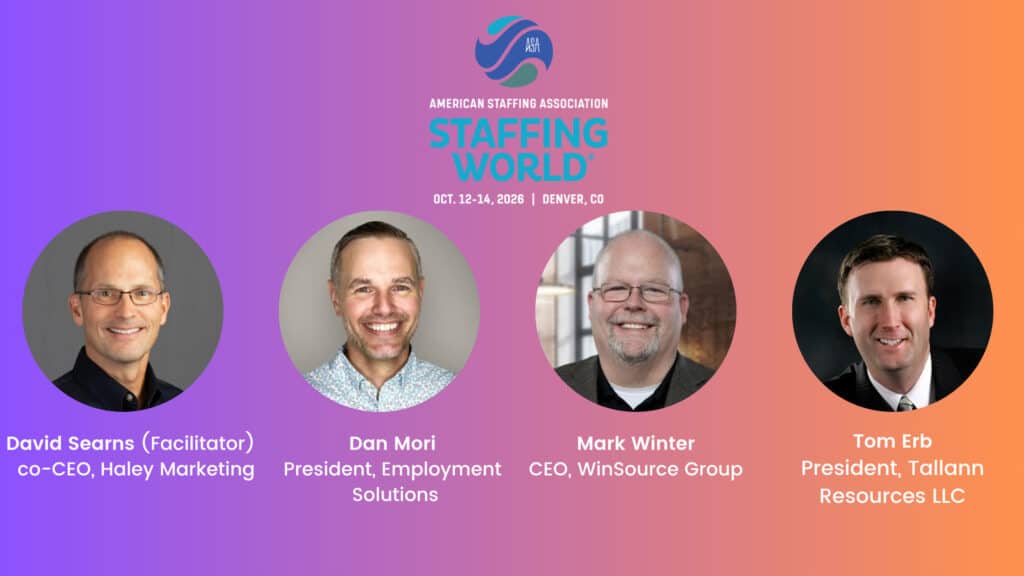
The distinguished executives on the panel behind the Staffing World session “Clarity Beats Chaos: How High-Performing Staffing Teams Stay Focused Under Pressure” seek to answer this question with practical advice gained from hard-won experience. This article previews their session, offering practical strategies to move from chaos to clarity, drive real progress, and build a culture of accountable performance.
Recognizing Chaos
Sometimes chaos looks like a busy team—but busyness doesn’t always equal progress.
Bad Data
Ericka Hyson gave an example of how activity data can be misleading.
“Maybe you are looking at analytics and see someone made fifty calls. But when you dig in a little, you see it was fifty calls to the same person who never bought anything. Sometimes talented people are working really hard on the wrong things. We might be giving a lot of glory on activity reports or rankings, but it hasn’t really created an outcome.”
Too Many Cooks
Beth Garvey mentioned a real-world example of chaos, when her team overhauled all of their technology over the course of a few years. Too many meetings without the right people walking away with clear action plans led to a breakdown.
“It was a matter of siloed departments that didn’t realize that they needed to talk to the other department as these things were getting built, and so the go-live for one of our departments was a disaster.”
Alignment Issues
Rhona Driggs says that the speed that staffing requires means chaos often masquerades as productivity – and alignment gets lost.
“Leadership says one thing, operations interprets it another way, sales optimizes for something different, and the field is left trying to reconcile competing priorities,” she says. “Everyone is busy, but not necessarily aligned. So the signal I look for is simple: if I ask five people what the most important objective is right now and get five different answers, we don’t have an execution problem. We have an alignment problem.”
Unclear Goals
For Jaime Donnelly, chaos happens when the team doesn’t understand what matters.
“When you don’t have clarity as an organization about what the outcomes are, that we’re all marching toward together, then chaos is bound to rear its ugly head.”
Hyson also described how leaders can unintentionally create chaos with casual comments, causing teams to pivot away from strategic goals.
“As leaders and founders… one of the biggest risks is when the loudest thing becomes the most important thing. And sometimes we don’t realize how much power we have in the words that we choose.”
Seeking Clarity
The group agreed that the antidote to chaos is clarity. Clarity from the top down, goals understood by all, and a willingness to reset when things get loud.
Fewer Priorities, Discussed Often
Donnelly pointed to a specific practice that she employs: annual 12-month mapping. Using this framework, she sets a limited number of goals that are easily understood across the organization.
“We’re not talking three-to-five year outcomes. We’re talking twelve-month outcomes. We discuss what the outcomes are, and ensure that they are cascaded appropriately within the organization so that everyone within the company understands what our goals are. They’re not complex, they’re in plain language, using few words, and there’s only three to five of them. When you can do that, then the noise falls away.”
Using these priorities as a filter, the panel says that if a new, “shiny object” doesn’t drive one of these outcomes, it gets set aside.
“Organizations are very good at adding and not nearly as good at subtracting priorities,” says Hyson. “If that’s the case, then eventually everything is important, which means nothing really is.”
Drilling Down
Driggs suggests using a three-question framework to determine a true priority from a project:
1) If we execute this perfectly, what measurable outcome improves? Revenue, profitability, customer experience, productivity, retention, etc.
2) What are we willing to stop doing in order to make room for it? Every true priority should displace something else.
3) Does it change what a recruiter, salesperson, or branch leader does on Monday morning?
“If we can’t clearly answer each question, it may be important, but it’s probably not a priority,” says Driggs.
Modeling Good Behavior
The group agrees that leaders must be willing to say “no” to new initiatives or decide what to stop doing to make room for something new.
“You’ve got to build that muscle memory to say, this doesn’t meet the decision filter, so I’m pushing it out,” says Donnelly.
Driggs adds, “The hardest part isn’t choosing what to start. It’s deciding what not to do.”
She goes on to say that one of the most impactful things a leader can do is to publicly stop something.
“When a leader says, ‘We’re not doing this anymore because it doesn’t support our most important outcomes,’ it sends a powerful message to the organization. It tells people that focus matters, that trade-offs are real, and that not everything deserves equal attention.”
Source of the Noise
Leaders also need to recognize when they are the source of the noise, says the group.
“The higher you go in leadership, the louder your casual comments become,” says Hyson. “While you might think it’s casual to say ‘we should really look into that’, you may unknowingly send people off in a completely different direction.”
Hyson suggests that before you introduce something new, challenge yourself: is it important now? Is it mine to solve? And before adding it, what are we potentially going to take away?
Garvey adds that it helps to have at least one “truth teller” member of your executive team who is willing to call you on it.
Accountability as a Shared Discipline
According to the panel, accountability does not have to be a punitive measure – instead, leaders should reframe it as a positive, shared practice.
Donnelly says that it’s all about creating a culture where people feel safe to fail, as long as they “fail accountably” by communicating a potential miss early and committing to a new plan.
“When you can create a culture where people are safe to fail, then they will try and try and try. When you can create that versus have it be a hammer, then that accountability is easier for people to accept and own.”
Garvey adds that being consistent with accountability will serve you as a leader.
“Everybody watches to see if you are consistent in your treatment of everybody across the board. Your people need to understand that how you hold everyone accountable is consistent, not based on who they are.”
Hyson suggests that before diagnosing an accountability problem, a leader should ask if it’s really a clarity problem.
“Before deciding if someone is or isn’t accountable, first you should be asking whether the outcome was really clear. Do they know what they were responsible for owning, what success looks like, why it matters, and when it should have happened? It’s really difficult to hold someone accountable for something that was never clear enough to own.”
Driggs likes to turn accountability from a reporting exercise into a problem-solving exercise.
“In team meetings, I like to spend less time discussing what’s on track and more time discussing what’s at risk. In one-on-ones, I ask, ‘What’s getting in your way?’ and ‘What do you need from me?’ Because the goal isn’t to catch people missing goals. The goal is to help people achieve them.”
From Theory to Practice
Donnelly suggests a practical way to move through chaos is to shift the measurement of success from “how busy are we?” to “what did we achieve?” Sometimes that looks like a visual tool or scoreboard that everyone can see.
“If you can get the organization to focus on the outcome, the goal, and that score that goes up on the scoreboard—that is going to be more impactful than the chaos of busyness.”
Alignment Across Teams
Hyson says that a specific exercise is to ask your leadership team to write down the three most important outcomes that the organization needs to accomplish right now and compare answers.
“It helps you see how aligned your team is and to make sure you have clarity on what the most important things are.”
Driggs takes it a step further and suggest to do the same with a team 2-3 levels down from executive level.
“The best organizations are relentless about checking whether the message actually made it to the people responsible for executing it. Clarity isn’t what leadership says. Clarity is what the organization understands.”
Start, Stop, Continue
Garvey suggests implementing a regular practice of asking what the team should start, stop, and continue doing—and giving people permission to stop doing work that no longer adds value.
“You should constantly ask the question of what you should stop doing. There are so many things that people do on an everyday basis that used to be important, but maybe are not anymore. Take the time to ask, why do you do this report? Who looks at it? There are so many times people don’t even look at it.”
This Could Have Been an Email
Driggs suggests eliminating meetings where decisions aren’t made. While organizations rarely suffer from lack of discussion, they do suffer from delayed decisions.
“We’ve all been in meetings where everyone talks, everyone leaves, and nobody can clearly articulate what was decided, who owns it, or what happens next. Those meetings create the illusion of progress while actually generating more confusion.”
Center the Customer
Hyson suggests that when things feel chaotic, that’s an opportunity to pause and reframe the situation by asking: is the customer at the center of every decision?
“Sometimes you have to ask, are we easy to do business with right now? It’s really a chance to take a time out and talk about what the most important thing is—and if it’s not the customer, then you might have a bigger problem.”
Clarity Above All
The message from the panel is clear: a leader’s primary job is to create clarity. Clarity leads to focus, focus creates accountability, and accountability drives results.
Driggs sums it up nicely: “A strategy only becomes real when the people closest to the customer understand it, believe it, and know exactly what they need to do differently because of it.”
The group says that their interactive panel at Staffing World will challenge leaders to hold up a mirror to themselves and provide actionable strategies to turn chaos into clarity.
“We are going to have so much fun challenging ourselves on how much of the chaos we’re trying to solve, might be chaos that we are creating,” says Hyson. “Come to the panel to find out!”
Thank you so much to Jaime Donnelly, Rhona Driggs, Ericka Hyson, and Beth Garvey for speaking to us about this topic! You can catch them in action at the breakout session “Clarity Beats Chaos: How High-Performing Staffing Teams Stay Focused Under Pressure” on Tuesday, Oct. 13 from 11:30 am – 12:15 pm.
Up Next





Read More Insights from Elle Jackson
-

A Billion Dollar Mistake: Why You Can’t Ignore Job Descriptions in an AI World
An interview with Kat Kibben on the “billion dollar mistake” in staffing – ignoring job descriptions in an AI world. -
No One Wants to Talk to You; Here’s How to Get the Sale Anyway
When it comes to staffing sales these days, no one wants to talk to you. Here’s how to win business anyway. This article is a preview of a panel at Staffing World that distills candid advice from experts on how to win business in a difficult sales environment. -

The Practical AI Playbook for Staffing Firm Leaders
In this webinar replay, marketing and AI expert Jeff Staats offers a free educational webinar designed specifically for staffing firm leaders who want to leverage AI with confidence—not confusion. In this webinar recording, you’ll learn how to cut through the noise and identify practical ways AI can help your team work smarter, improve efficiency, and… -

What You Need to Know About California Senate Bill 1032 – the SAFE Act (SB 1032)
Everything you need to know about California Senate Bill 1032, also known as the SAFE Act, and how it impacts staffing agencies in CA.