
How Invoice Factoring Works: A Step-by-Step Guide for Staffing Agencies
Staffing agencies face a constant balancing act: paying talent weekly while waiting 30, 60, or even 90 days for clients to pay invoices.
Invoice factoring helps bridge that gap. Rather than taking on debt, staffing agencies can turn outstanding invoices into immediate working capital, giving them the cash they need to cover payroll, support growth, and operate with confidence.
Here’s how the invoice factoring process works, step by step.
What is Invoice Factoring in Staffing?
Invoice Factoring is a financial agreement where the staffing agency sells its unpaid customer invoices to a third-party, also known as the factor, to receive immediate cash. This process eliminates the 30-90 day wait for a client to pay on the invoice.
- The Seller (Your Staffing Firm): Delivers the talent and generates the invoice.
- The Debtor (Your Client): The enterprise, VMS program, or business paying the invoice.
- The Factor (Advance Partners): The funding partner providing immediate capital.

The Step-by-Step Lifecycle of a Factoring Transaction
Step 1: Fulfillment & Time Tracking:
Your agency places the talent, workers log their hours via an ATS or VMS system, and the client approves the timesheets.
Step 2: Invoice Generation & Submission:
You generate the invoice with correct rates, PO numbers, or cost centers, and submit a copy to Advance Partners.
Step 3: The Advance Fee (Up to 90%+ Initial Funding):
Advance Partners verifies the data and immediately wires an upfront cash advance (typically 80% to 90%+, or up to 100% in full-service setups) into your bank account—usually within 24–48 hours—allowing you to run weekly payroll seamlessly.
Step 4: Client Payment Over Normal Terms:
Your client pays the invoice according to their agreed-upon Net 30, 45, or 60+ terms directly to a secure lockbox monitored by the factor.
Step 5: Rebate Release (The Final Balance):
Once the client settles the bill, Advance Partners releases the remaining balance (the “reserve”) back to your staffing agency, minus a small, transparent factoring fee.
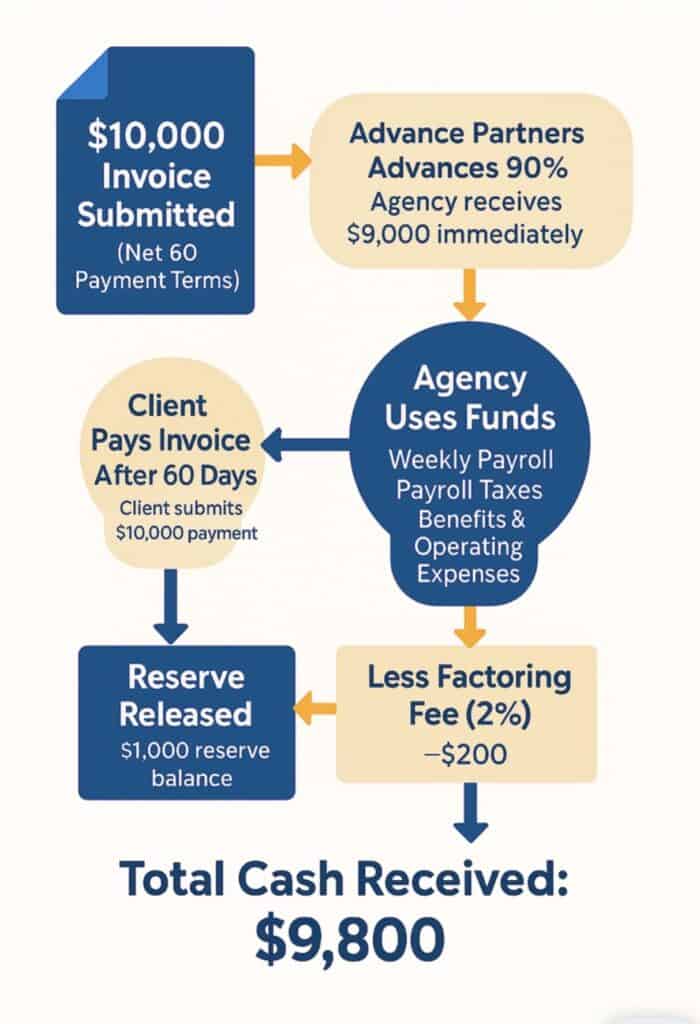
A Real-World Staffing Factoring Example: The Math Breakdown
- Example framework: A staffing agency submits a $10,000 enterprise invoice on a Net 60 term.
- Advance Partners approves a 90% advance rate, instantly wiring $9,000 to cover payroll on Friday.
- Sixty days later, the client pays the full $10,000.
- Advance Partners releases the remaining $1,000 reserve, minus a hypothetical 2% factoring fee ($200). The agency receives the remaining $800 cash rebate.
Recourse vs. Non-Recourse Factoring: Managing Credit Risk
Recourse Factoring
Recourse factoring improves cash flow, but the client remains responsible if an invoice isn’t paid.
- You get fast access to cash
- We support collections
- But if a customer doesn’t pay, the invoice is ultimately charged back to you
Non-Recourse Factoring
Non-recourse factoring provides built-in protection—if an approved customer becomes unable to pay due to a credit event, the factoring company absorbs that loss.
- You still receive immediate cash for your invoices
- But importantly, you’re protected if your customer fails financially
- This reduces your exposure to bad debt and unexpected losses
Why Staffing Agencies Prefer Factoring Over Traditional Bank Loans
Bank lines of credit can be hard for staffing firms to qualify for and even harder to use strategically during rapid growth. They often require hard collateral, years of profitable operating history, and come with strict debt covenants that can limit flexibility right when you need it most, especially during a sudden spike in client demand and hiring.
Factoring works differently. It provides non-debt working capital tied directly to your invoices, not your balance sheet. That means as your billing increases, your accessible payroll funding grows automatically. For staffing agencies, that creates a major strategic advantage: you can keep placing talent and meeting payroll without waiting on slow customer payments or worrying that growth will outpace your credit line.


The Onboarding Process: How Fast Can Your Agency Get Set Up?
This process will vary from funder to funder. WIth Advance Partners, the initial onboarding process typically takes anywhere from a few business days to two weeks. Once you are set up as an account and the relationship is established, the cash advances for your daily or weekly invoices are typically sent to you the same day they are requested.
Ready to Grow?
Let’s Talk Staffing Funding.
You don’t have to wait for payments to make payroll or say no to growth. With the right partner, you can scale with confidence.