
Calculate How To Price Your Staffing Services

Our pricing resources help you get it right. Learn how to calculate staffing bill rates, set competitive markups, and protect your margins with clear pricing formulas.

Recruitment Agency Bill Rate, Markup, Fees & More

So you’ve started a staffing firm or are thinking about starting one. Now, what should you be charging customers to keep competitive and still make a profit? Use the profitability calculator to determine staffing and recruitment Agency Bill Rate, Markup, Fees & More.

Calculate Your Profitably Now

Why Getting Pricing Right Matters for Staffing Firm Profitability

Pricing impacts everything: your ability to scale, cover overhead, and compete in tight labor markets. Mispriced services lead to lost bids, poor cash flow, and eroded gross margins. Understanding burden rates, markups, and industry benchmarks helps you avoid costly mistakes – and gives you the confidence to quote rates that win and sustain your business.

How to Price Your Staffing Firm Services

Owning a staffing firm can be profitable, but only if you know what to charge your customers. Charge too much; you might lose contracts to your competitors. Too little, and you are undervaluing your services and cutting into your profit margin. Striking the right balance is key and a big challenge for this competitive industry.

To succeed in your staffing business, you need a comprehensive understanding of pricing and everything that goes into it. To get you started, we have laid out some basic pricing terminology and definitions, as well as a sample profit assumption to help determine your bill rate.

Pricing correctly is a difficult balance to strike, so we’ve compiled a few simple points to keep in mind. For a more in-depth look into pricing, download the free How To Price Your Staffing Services whitepaper.

Factors That Influence Your Bill Rate (Beyond Pay + Markup)

Pricing isn’t just pay rate plus a standard markup. Consider:

  • Industry-specific risk: Healthcare, industrial, and IT each carry different burden assumptions, credentialing requirements, and fall-off risks that impact your pricing.
  • Market demand and candidate scarcity: Tighter markets require higher pay rates and often higher markups to attract talent.
  • Client contract terms: MSP/VMS fees and longer payment terms (Net 45–90) directly affect profitability and cash needs.

The Components of Pricing
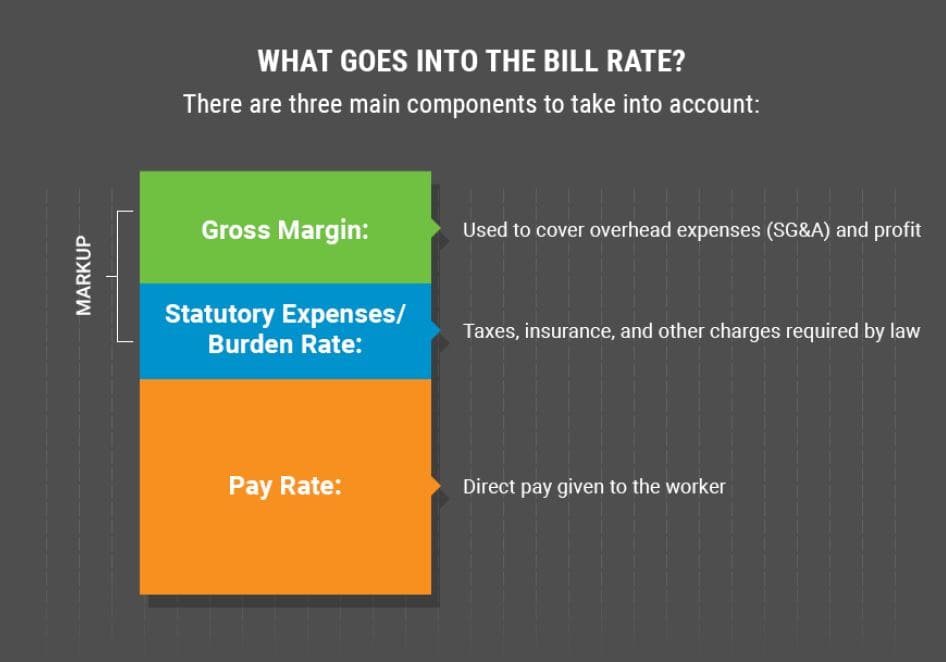
Bill rate is the rate a company pays to a staffing agency for the services of a temporary worker. There are several components of pricing to take into account when figuring out your bill rate.

Many different factors go in to pricing out your staffing firm services, so in this whitepaper we will discuss the major components in order to help you determine a fair rate to charge your clients while keeping your business in the black.

Gross Margin

The amount of money a staffing firm gets to keep after paying the temporary workers’ payroll, benefits, payroll, and other statutory expenses. Gross profit margin dollars are used to pay internal overhead costs and the owner’s profit.

Burden Rate or Statutory Expenses

Taxes, insurance, and other charges required by law. For staffing firms, it includes:

Federal Unemployment Tax (FUTA)

Unemployment taxes paid to the Federal government. The FUTA rate is 6.0% with a wage base of $7000, and employers can take a credit of up to 5.4% of taxable income if they pay state unemployment taxes. If you qualify for the highest credit, then the minimum FUTA rate is .6%.

Social Security and Medicare Tax Rate (FICA)

A single flat fee/ rate to all employers of 6.2% for social security and 1.45% for Medicare tax. This is capped at a salary of $137,700 for Social Security for each employee in 2020. There is no cap on Medicare tax.

State Unemployment Insurance Tax (SUTA)

Rates and taxable wage limits vary significantly from state to state. And Worker’s Compensation Insurance.

Worker’s Compensation Insurance

An insurance policy that covers work-related injury and illness. Workers comp insurance rates vary by skill type, vendor, and stat.

Markup

A percentage charged by the staffing firm on top of the pay rate. Markups can include various factors; statutory expenses, overhead and operating costs, and profit. Operating expenses can cover rent, equipment, recruiting fees, commissions, and more.

Pay Rate

The pay rate is the direct pay given to the worker and makes up the majority of the bill rate.

Profit Margin

A measure of profitability is calculated by taking net profit (revenue-cost) and dividing it by revenue.

Real-World Examples of How Costs Add Up in Different Industries

Pricing isn’t a one-size-fits-all in staffing. Different industries mean different costs. Consider for example:

  • Industrial staffing: Higher Workers’ Comp rates increase burden. Plan a higher markup to maintain margin.
  • Healthcare staffing: Credentialing, background checks, and rapid response add overhead and fall-off risk. Remember to factor these into markup.
  • IT staffing: Higher pay rates with typically lower Workers’ Comp. Pricing strategy often focuses on tighter operations and competitive but disciplined markups.

Learn more about our staffing and recruitment payroll tax services and solutions.

What Is The Average Staffing Agency Markup?

What do staffing agencies charge? The average staffing agency markup for temporary employees or independent contractors can range anywhere between 20 – 75%. Permanent placement markups are typically 10 – 20% of the employee’s gross annual salary.

Benchmarking Your Markup Against Industry Standards

What is standard pricing in your industry, and how do you stay competitve? Here are a few actions to consider:

  • Adjust for contract size, specialty, location, risk profile, MSP/VMS fees, and payment terms.
  • Research local competitors and your niche to understand typical pricing by role and geography.
  • Compare your markup to industry averages to ensure you remain competitive and profitable.

Calculating A Profitable Scenario

Let’s say you have an administrative assistant on assignment who has a pay rate of $15. Assume your burden rate is 12%. Assume your mark-up is 50%.

The formulas you need are as follows:

  • Bill Rate = Pay rate * (1+Mark-up)
  • Direct Cost of Labor = Pay rate * (1+Burden rate)
  • Gross profit margin = Bill Rate – Direct Cost of Labor

Now let’s put the numbers into the formulas:

  • What is your Bill Rate? – $15 * (1+.5) = $22.50
  • What is your Direct Cost of Labor? – $15 * (1+.12) = $16.80
  • What is your Gross Margin? – $22.50 – $16.80 = $5.70 per hour

The $5.70 hourly gross margin is what you have as a staffing company to cover your overhead and your net profit.

How does mark-up affect gross margin?

Markup affects gross margin by increasing the amount a staffing agency earns over the worker’s pay rate. The higher the markup, the larger the difference between the bill rate and the direct labor cost. This difference contributes to the agency’s gross margin, which covers operating expenses and profits. Essentially, the higher the markup, the more room the staffing agency has to maintain profitability while covering costs like taxes, insurance, and overhead. A well-set markup ensures a healthy gross margin for the business.

Let’s take the same example and calculate using a 30% markup rather than 50%.
$15 * (1+.3) = $19.50
Your direct cost of labor stays the same: $15 * (1+.12) = $16.80.

What is your new gross margin?

Changing your markup from 50% to 30% has a significant impact on your gross margin. ($2.70/hr compared to $5.70/hr)

Common Pricing Mistakes New Staffing Firms Make

Here are some common pricing mistakes to avoid as a new staffing firm owner:

  • Forgetting to include recruiter commissions, technology, and admin overhead in markup calculations.
  • Underestimating burden costs and netting far lower margins than expected.
  • Using the same markup across all clients instead of adjusting for risk, industry, and contract terms.

Try The Staffing Profitability Calculator

PER HOUR
Cost Burden:
Gross Profit:
Gross Margin:
TOTAL CONTRACT
Total Hours/Week:
Gross Profit/Week:
Gross Profit Total Contract:
Thank you, an email was sent.

The right funding starts with people. That’s us. Experts dedicated to the staffing industry and talented people who make it work.

Considerations Beyond Pricing

When starting a firm, we think there are four key things you must consider:

The people you hire are by far your most important asset, and sound technology infrastructure is critical. For a new firm, you will need various insurance policies such as Worker’s Compensation. Finally, you’ll have to secure the appropriate working capital. Startup temporary staffing businesses have significant and immediate cash flow needs. It’s up to you to figure out which financing option works best for your goals.

How Client Contracts Impact Profitability (Hidden Cost Drivers)

Contracts can hide cost drivers in plain sight – if you know what to look for. Consider these:

  • Discounts, rebates, guaranteed fill rates, and penalties can significantly impact margin and should be modeled before you sign.
  • Longer payment terms (Net 45–90) increase your working capital needs and cash risk.
  • MSP/VMS fees reduce your effective markup and must be included in your pricing model.

When to Adjust Pricing for Existing Clients

To know when to adjust pricing, here are some keys to remember:

  • Revisit markup when client requirements increase (screening, onboarding, credentialing).
  • Review burden rate changes annually (SUTA, workers’ comp, FICA caps).
  • Adjust pricing when candidate pay rates rise in competitive markets.

Common Questions On Pricing Staffing & Recruitment Services

According to the Gross Margin and Bill Rates Trend report from Staffing Industry Analysts, the gross margin among staffing firms is typically between 14 and 41 percent, with an average aggregate gross margin among temporary staffing firms of 25%. While industries vary, profit margins in staffing are typically healthy, if not huge.

Billing rate refers to the amount that a staffing agency charges their clients for the services of their
employees. It is typically expressed as an hourly rate and includes the costs of wages paid to the
employee, plus additional charges that cover payroll taxes, workers’ compensation, administrative fees, and the staffing agency’s profit. This rate is crucial in the staffing industry as it directly impacts the agency’s revenue and profitability.

To calculate the pay rate from the bill rate, staffing firms need to subtract the costs associated with
employment and their desired profit margin from the bill rate. Here’s a simplified formula:

Pay Rate = Bill Rate − (Payroll Taxes + Workers’ Compensation + Administrative Fees + Profit Margin)

This calculation helps staffing firms determine how much they can afford to pay their employees while maintaining profitability.

The profit margin for staffing agencies can vary widely depending on the sector and the efficiency of the agency’s operations. Typically, profit margins in the staffing industry range from 2% to 10%. Higher-
margin specialties often include IT, engineering, and healthcare staffing, where the demand for skilled
professionals allows agencies to command higher bill rates relative to pay rates.

Staffing agencies get paid by their clients based on the billing rate agreed upon for the placement o their employees. Payment is usually tied to the number of hours worked by the employee, billed either weekly or monthly. Agencies invoice their clients after the services have been rendered, and payment terms can range from net 15 to net 60 days, depending on the contract

The amount a staffing agency makes off employees is the difference between the bill rate charged to the client and the pay rate given to the employee, minus any associated employment costs. This difference, known as the markup, typically ranges from 25% to 100% of the pay rate, depending on the industry, the type of job, and market conditions. The markup covers the agency’s operating expenses and contributes to its profit.

No. Statutory fees can vary widely based on location and skill set. State unemployment insurance costs can vary by state as well as supplier. For example, one supplier may have 10% higher SUI fees in one state over another.

Besides the statutory expenses and gross margin, there are factors to consider, including the number of temps needed, duration of the hiring process, amount of recruitment time required, compensation level of the resource, etc. Your markup can vary based on these factors.

Some buyers might balk at a 50% markup, thinking that your firm is intentionally gouging them to make a considerable profit. That is not usually the case because the majority of the markup will pay for expenses with a bit of leftover for profit. Unless they have intimate knowledge of payroll or accounting, some customers simply are not aware of what it costs to be an employer. The buyer should also be mindful of the costs they are saving by hiring a temporary worker: benefits, training, vacation, etc.

No. Typically, a staffing agency defines custom pricing based on a client’s anticipated volume, rate management approaches, location, turnover rates, ease of filling the skill set, and knowledge relative to the applicable bill rates.

Here are some factors to consider:

  • Target profit: The gross margin dollars you need per hour to cover overhead and produce net profit. Tip: Build your rate from the bottom up (pay + burden + overhead per hour + target profit), then check market acceptance. Use a calculator to sanity‑check different scenarios.
  • Pay rate: The hourly wage paid to the worker.
  • Statutory burden: Employer payroll taxes and mandated costs (FICA employer share, FUTA, SUTA, Workers’ Compensation), plus any state/local payroll taxes or mandated benefits. Use current-year, state-specific rates.
  • Direct assignment costs: Background checks, drug screens, credentialing, onboarding, PPE, badging, travel/per diem (where applicable).
  • Overhead: Recruiter/AM compensation and commissions, job boards, ATS/CRM, office/remote tools, insurance (general liability, E&O), training, and admin.
  • Program and contract costs: MSP/VMS fees, rebates/discounts, required guarantees, and any penalties or service credits.
  • Working capital considerations: Longer net terms increase your financing costs and cash risk; model DSO and the cost of capital.

MSP/VMS fees reduce your effective margin if you don’t account for them upfront. Treat program fees like a cost of sale:

  • Longer payment terms common in VMS programs raise your working capital needs—model the cash impact alongside the fee. Practical approach: Start with your target gross margin dollars per hour. Add program fees and expected DSO cost to your costs, then solve for the bill rate/markup that preserves your margin.
  • If the fee is a percent of bill rate, your effective markup drops by that percentage unless you increase rate or markup to compensate.
  • If the fee is a flat dollar or per‑transaction charge, add it to your cost stack before calculating your target margin.

At minimum, annually at renewal—and more often when key inputs change. Revisit pricing when:

  • Pay rates move in competitive markets or due to minimum wage changes.
  • Burden shifts (new SUTA rates, Workers’ Comp class changes, updated FICA wage base).
  • Client requirements expand (added screening, credentialing, reporting, on‑site services).
  • Contract economics change (MSP/VMS fees, rebates, net terms).
  • Your own overhead materially changes (tech stack, job board costs, compensation plans). Best practice: Bake review triggers into contracts (e.g., annual adjustment or CPI/market pay clauses) and conduct quarterly business reviews with high‑volume clients.

Yes, risk profile, compliance needs, and pay dynamics vary by vertical.

  • Light industrial: Typically higher Workers’ Comp rates and higher turnover. Plan for higher burden and redeployment costs; win with speed, tight operations, and disciplined markup.
  • Clerical/administrative: Moderate burden and pay rates; focus on process efficiency, quality, and competitive, sustainable markups.
  • Healthcare: Heavy credentialing/compliance, rapid response, and higher no‑start risk. Include screening/credentialing overhead, on‑call costs, and fall‑off risk in pricing.
  • IT/professional: Higher pay rates with generally lower Workers’ Comp. Percentage markups may be lower, but dollar spreads are larger; prioritize quality, niche expertise, and longer assignment terms. Calibrate by role, geography, and client requirements—not just by category label.

There’s no universal “best” markup—start with the math for your niche and market. A practical approach:

  • Calculate burden using current, state‑specific rates.
  • Estimate overhead per hour (total monthly overhead divided by expected productive hours).
  • Set a target profit per hour that supports growth.
  • Solve for the bill rate/markup that covers those inputs and test market acceptance. Reference points: Temporary/contract markups often range from 20%–75% depending on role, risk, and market; permanent placement fees often run 10%–20% of first‑year salary (sometimes higher for hard‑to‑fill roles). New firms should avoid “buying” business with unsustainably low rates; price for durability and deliver superior service.
  • Reduce costs you control: Improve safety to lower Workers’ Comp, fine‑tune SUTA via claims management, and standardize onboarding to cut rework.
  • Optimize mix and productivity: Focus on roles/clients with better margins and higher fill velocity; raise recruiter productivity to lower cost‑to‑fill.
  • Tighten operations: Reduce fall‑offs and no‑starts with better screening and day‑one check‑ins; invoice faster and chase approvals to shorten DSO.
  • Reframe value: Share performance metrics (fill rate, time‑to‑submit, quality) and the cost of added requirements; propose tiered service options.
  • Adjust terms: If rate moves are off the table, negotiate shorter payment terms, minimum order sizes, or reduced add‑on requirements.
  • Manage cash flow: Use tools like payroll funding to bridge long terms without starving growth, and model program fees so they’re reflected in pricing. Often, small, data‑backed adjustments across mix, process, and terms can recover margin without headline rate increases.
  • Markup (%) is how much you add to pay rate to get bill rate.
    • Markup = (Bill Rate – Pay Rate) ÷ Pay Rate
  • Gross margin is what you keep after direct labor costs (pay + statutory burden).
    • Gross Margin Dollars = Bill Rate – (Pay Rate + Burden)
    • Gross Margin (%) = Gross Margin Dollars ÷ Bill Rate Why it matters: Two deals with the same markup can yield very different margins if burden, fees, or terms differ. Always price to a target gross margin (dollars and percent), not just a markup percentage. A calculator helps you see the true impact before you quote.